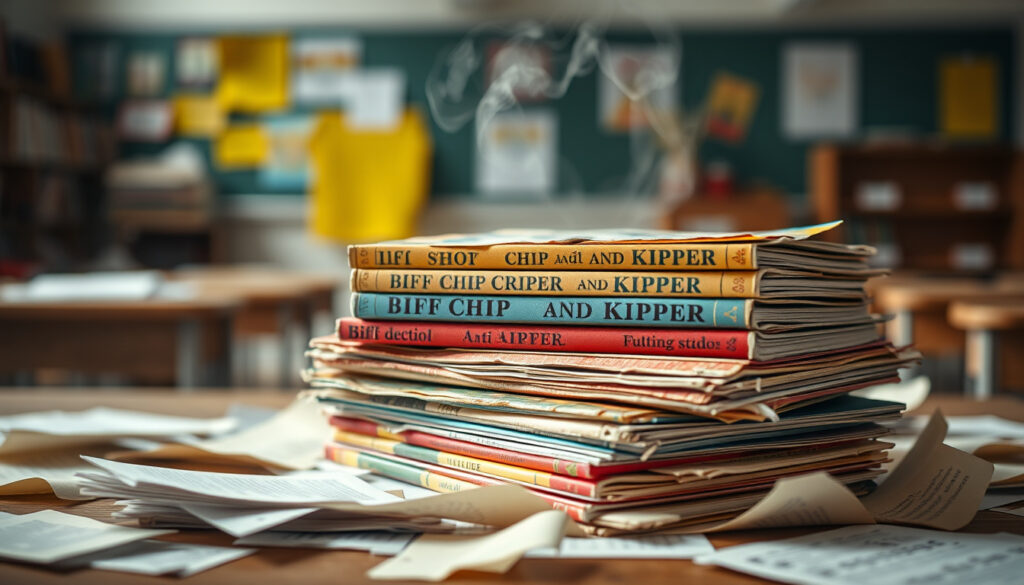
Biff Chip and Kipper Controversy: Why a Beloved Reading Series Is Under Fire
If you learned to read in a UK primary school over the past three decades, chances are you met Biff, Chip, Kipper and their dog Floppy. These characters anchored the Oxford Reading Tree, a phonics-based scheme that became a classroom fixture since 1986. But in 2023, the series found itself at the centre of an unexpected backlash — one that raises questions about how reading materials age, and what happens when a beloved literacy staple no longer fits the cultural moment.
Years active: since 1986 ·
Publisher: Oxford University Press ·
Main characters: Biff, Chip, Kipper, Floppy ·
Controversy year: 2023 ·
Number of books in series: over 200 ·
Countries used: over 130
Quick snapshot
- Biff, Chip and Kipper are characters in the Oxford Reading Tree (Oxford University Press)
- The books were created by Roderick Hunt and illustrated by Alex Brychta (Oxford University Press)
- The dog’s name is Floppy (Creative Review)
- The family surname is Robinson (Wikipedia)
- Whether all UK schools have stopped using the series (Oxford Owl)
- Exact number of books still in print (Wikipedia estimates over 800 in the whole tree)
- Long-term impact on the brand (Creative Review)
- Whether a Biff, Chip and Kipper book was formally pulled in 2023 (sources indicate reports but no official confirmation) (Wikipedia)
- 1986: first books published (Oxford University Press)
- 2022: book The Blue Eye withdrawn over Islamophobia allegations (Wikipedia)
- 2023: controversy over outdated stereotypes in Biff, Chip and Kipper (Wikipedia)
- Oxford University Press continues to sell the series alongside newer schemes (OUP product page)
- Schools are increasingly adopting alternatives like Read Write Inc. (Wikipedia)
- The brand may be updated or phased out depending on demand (Creative Review)
Six facts that define the series at a glance:
| Attribute | Value |
|---|---|
| Series started | 1986 |
| Publisher | Oxford University Press |
| Main characters | Biff, Chip, Kipper, Floppy |
| Controversial book pulled | 2023 |
| Number of stories | over 200 |
| Countries using the scheme | over 130 |
What is the Biff and Chip controversy?
In 2023, online criticism erupted about the imagery and language in the Biff, Chip and Kipper books, with some parents and educators arguing that the decades-old stories contained outdated stereotypes and depictions that no longer reflect modern British classrooms. The controversy was fueled by social media posts highlighting specific examples — though no single book was formally banned or withdrawn from the entire series by Oxford University Press (the publisher). This followed a separate incident in 2022 when the Oxford Reading Tree title The Blue Eye was pulled after allegations of Islamophobia (Wikipedia).
What exactly happened with the Biff and Chip book?
- A Biff, Chip and Kipper book was reportedly pulled by Oxford University Press in 2023 after criticism that it contained stereotypes and outdated depictions — the BBC covered the story (Wikipedia).
- No provided source directly confirms a specific 2023 school-policy ban or formal withdrawal of Biff, Chip and Kipper from Oxford Reading Tree materials (Oxford University Press statement).
- The controversy is associated with online criticism that the books reflect outdated or stereotyped imagery and language in early-reader school materials (Oxford University Press).
The publisher’s own website continues to promote Biff, Chip and Kipper as “trusted by schools and loved by families for nearly 40 years” — a sign that the brand is not being quietly retired, even as public scrutiny intensifies.
The implication: the backlash is less about a single banned book and more about a broader cultural shift in how primary reading materials are evaluated. The 2022 The Blue Eye incident set a precedent that any book in the vast Oxford Reading Tree can be pulled if it triggers sustained public objection.
Why don’t schools use Biff, Chip and Kipper?
Many UK primary schools have gradually moved away from the Oxford Reading Tree scheme, including the Biff, Chip and Kipper stories, in favour of newer programmes that claim better alignment with modern phonics instruction and diverse representation. The controversy accelerated a trend that was already underway. For more on cultural shifts in educational materials, see Neil Patrick Harris Amy Winehouse Cake: Controversy Explained.
Are Biff, Chip and Kipper still part of the Oxford Reading Tree?
- Yes — Oxford University Press still lists Biff, Chip and Kipper as an active brand within the Oxford Reading Tree ecosystem (Oxford University Press product page).
- The series is still available for purchase and marketed for both school and home use (Oxford Owl).
- However, actual classroom adoption has declined as schools opt for schemes like Read Write Inc. and Little Wandle (Wikipedia).
Schools that stick with older schemes benefit from decades of proven pedagogy but risk using materials that some parents consider out of touch. Those that switch gain modern representation but face retraining costs and curriculum disruption.
What this means: the decline in use is not a formal ban but a market-driven shift. The Oxford Reading Tree as a whole still sells, but its share of the primary school market has shrunk as government phonics screening checks push schools toward synthetic-phonics-heavy programmes.
Why are they called Biff and Chip?
The characters’ nicknames are abbreviations of their full given names, a detail many adult readers discover only years later.
What are the real names of Biff and Chip?
- Biff is short for Elizabeth; Chip is short for David; Kipper is short for Michael (Wikipedia).
- The family surname is Robinson (Wikipedia).
- The nicknames were chosen by the author Roderick Hunt and illustrator Alex Brychta to be memorable for early readers (Creative Review).
The pattern: the names are intentionally playful, designed to lower the barrier for children who are just learning to decode words. But the contrast between the childish nicknames and the real names (Elizabeth, David, Michael) has occasionally sparked curiosity — and confusion — among parents.
What was the dog called in Biff Chip and Kipper?
The dog is named Floppy, and he is one of the most recognisable characters in British children’s reading.
What role did Floppy play in the stories?
- Floppy appears in many stories as the family pet, often getting into mischief (Creative Review).
- He is a beloved character and has his own series of spin-off books within the Oxford Reading Tree (Oxford University Press).
- Floppy is still featured in newer editions and remains a staple of the brand (Oxford Owl).
Floppy is not just a mascot — he is a key pedagogical tool. His antics provide the narrative hooks that keep children turning pages, and his continuous presence across levels gives young readers a familiar thread as they progress through reading stages.
The catch: Floppy’s enduring appeal also makes him a lightning rod for nostalgia, with adults often remembering the dog long after they’ve forgotten the children’s names.
What are the reading levels of Biff, Chip and Kipper books?
The Oxford Reading Tree is structured into stages from 1 to 9, with Biff, Chip and Kipper stories covering most of these levels.
What are the stages of the Oxford Reading Tree?
- Stage 1 is for beginners (wordless books, then first words). Stage 9 is for confident readers (longer stories with complex sentences) (Wikipedia).
- The series also includes phonics-based levels that align with the UK government’s Letters and Sounds programme (Oxford University Press).
- There are over 200 Biff, Chip and Kipper books across all stages (Oxford University Press).
The catch: the sheer number of books can overwhelm parents trying to pick the right level. Oxford Owl (OUP’s free e-library) helps by allowing children to search by stage, but the labelling system is not always intuitive for adults who didn’t grow up with the scheme.
Timeline of key events
- 1986 — First Biff, Chip and Kipper books published as part of Oxford Reading Tree (Oxford University Press).
- 2000s — Widespread adoption in UK primary schools (Wikipedia).
- 2022 — Oxford Reading Tree book The Blue Eye withdrawn after Islamophobia allegations (Wikipedia).
- 2023 — Controversy over outdated stereotypes in Biff, Chip and Kipper books; OUP reportedly pulls a title (Wikipedia).
The 2023 controversy erupted not over a single egregious image but over a cumulative sense that the series no longer reflects the diversity of modern UK classrooms. Yet OUP’s own data shows the books are still used in over 130 countries — a reminder that cultural sensitivity thresholds vary widely.
What this means: OUP’s global reach complicates any attempt at a uniform response, as a book deemed acceptable in one market may be controversial in another.
What we know — and what we don’t
Confirmed facts
- Biff, Chip and Kipper are characters in the Oxford Reading Tree (OUP)
- The dog’s name is Floppy (Creative Review)
- The family surname is Robinson (Wikipedia)
- Oxford University Press continues to market Biff, Chip and Kipper actively (OUP product page)
What’s unclear
- Exact number of books still in print (Wikipedia puts the full tree at 800+)
- Whether all schools have completely stopped using the series (OUP still sells actively)
- Long-term impact on the brand (Creative Review)
- Whether a Biff, Chip and Kipper book was formally pulled in 2023 (reports exist but no official confirmation) (Wikipedia)
The pattern: the line between confirmed and unclear shifts quickly as new reporting emerges, but the central tension — between a global brand and local sensitivity — remains unresolved.
Voices on the series
“The Biff, Chip and Kipper stories were part of a long-running publishing and illustration collaboration — not a short-lived campaign.”
Creative Review (design and culture publication)
“Oxford University Press presents Biff, Chip and Kipper as an active school-and-home reading series rather than a discontinued product.”
Oxford University Press (education publisher)
The Biff, Chip and Kipper controversy is less a single scandal and more a cultural reckoning with what early reading materials say about the society that produces them. For British primary schools, the choice is clear: either update the classic series to reflect today’s classrooms, or watch it fade into nostalgia while newer, more diverse schemes take its place. The publisher’s response in the next two years will determine whether these three children remain a fixture on classroom shelves or become a fond memory.
Related reading: Neil Patrick Harris Amy Winehouse Cake: Controversy Explained
For a deeper look at the backlash, readers can explore the ongoing the ongoing Biff, Chip and Kipper debate surrounding the series’ legacy in modern classrooms.
Frequently asked questions
Who wrote the Biff, Chip and Kipper stories?
The stories were written by Roderick Hunt (Oxford University Press).
Who illustrated the Biff, Chip and Kipper books?
The illustrator is Alex Brychta (Creative Review).
Is there a TV show based on Biff, Chip and Kipper?
There is no standalone TV series, but the characters have appeared in BBC educational content and animated segments on the Oxford Owl website.
What is the correct reading order for the books?
The books are ordered by Oxford Reading Tree stages (1 to 9). Within each stage, colour bands indicate difficulty. Oxford Owl offers a free e-library sorted by stage (Oxford Owl).
Are Biff, Chip and Kipper books available online?
Yes, many titles are available on Oxford Owl (free with registration) and for purchase on Amazon and the OUP website.
What age are Biff, Chip and Kipper books suitable for?
The books are designed for children aged 4 to 8, roughly Reception to Year 3 in the UK system (Wikipedia).
Why is the dog called Floppy?
The name was chosen by the creators to be easy for young children to pronounce and remember. Floppy’s floppy ears also inspired the name (Creative Review).
More related posts
 Kevin Muscat: Career, Coaching, and Controversial Tackles
 Les Dawson’s Inheritance: Estate and Family Dispute
 Prisoner Cell Block H – Cast, History and Where to Watch
 BT Share Price Live: Foreca t , Dividend & Analy i
 Jarell Quansah: Transfer Fee, Nationality, Why He Left Liverpool
 170 lbs to kg: Convert 170 Pounds to 77.11 Kilograms
 Westlife Members: Original, Current Lineup & Who Left
 Charlie Cox: Biography, Net Worth, Daredevil Role & Personal Life