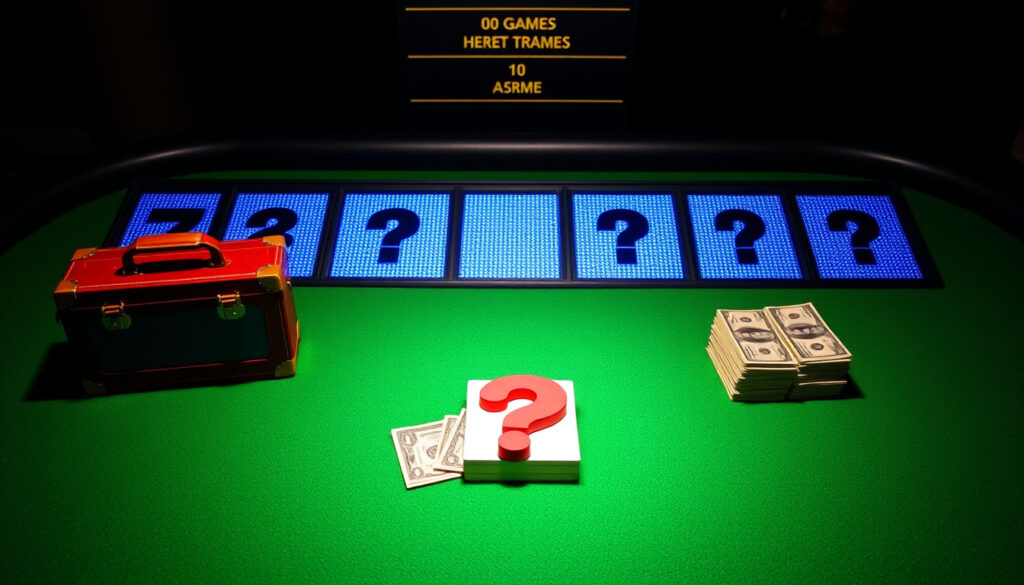
Deal or No Deal Game: Rules, Strategy & Best Versions
You’re sitting in front of 22 sealed briefcases, each hiding a different cash amount. One of them is yours to keep — if you can resist the Banker’s offers.
Number of briefcases: 22 ·
Highest prize (US version): $1,000,000 ·
Number of contestants per episode: 1 ·
Average offer percentage: ~80% of remaining expected value ·
Original UK air dates: 2005–2016
Quick snapshot
- 22 briefcases with cash amounts (Wikipedia, British game show)
- Pick one briefcase to keep (Wikipedia, American game show)
- Open others in rounds (UltraBoardGames, game rules portal)
- Receive Banker offers (UltraBoardGames, game rules portal)
- Decide Deal or No Deal (Illinois official contest rules)
- TV show (original) (Wikipedia, British game show)
- Board game (Drumond Park) (Drumond Park, board game manufacturer)
- Mobile app (Google Play) (UltraBoardGames, game rules portal)
- Online browser game (MSN) (UltraBoardGames, game rules portal)
- Casino slot machines (Wikipedia, British game show)
- Apply via official casting calls (Wikipedia, British game show)
- No quiz or skill test (Wikipedia, British game show)
- Selection based on story/personality (Wikipedia, British game show)
- Travel and hotel provided (Illinois official contest rules)
- Filmed over multiple days (Wikipedia, British game show)
- Calculate expected value of remaining cases (UltraBoardGames, game rules portal)
- Factor in personal risk tolerance (UltraBoardGames, game rules portal)
- Banker offers are usually below EV (UltraBoardGames, game rules portal)
- Consider ‘deal’ early if prize is life-changing (UltraBoardGames, game rules portal)
- No single ‘trick’ guarantees win (UltraBoardGames, game rules portal)
| Fact | Detail |
|---|---|
| Original air date (UK) | 31 October 2005 |
| Number of briefcases | 22 |
| Top prize (US version) | $1,000,000 |
| Show creator | Endemol |
| Notable host (UK) | Noel Edmonds |
How do you play Deal or No Deal game?
Setting up the game
Each game begins with 22 sealed briefcases, each containing a known cash amount. In the American TV version (Wikipedia, general encyclopedia), 26 briefcases are used, but the core principle is the same. The contestant stands at a podium and the briefcases are displayed on a board.
Choosing a briefcase
The contestant picks one briefcase to keep throughout the game — its value remains hidden until the end. According to UltraBoardGames (game rules portal), the contestant calls out one briefcase number at the start and that case is not opened until the final decision.
The Banker’s offer is almost always below the expected value of the remaining briefcases. Contestants must weigh the certainty of cash now against the chance of a larger sum later — a classic risk-reward puzzle.
Opening cases and bank offers
In each round, the contestant opens a set number of remaining briefcases. The first round requires opening 6 cases, as per UltraBoardGames (game rules portal). After each round, the Banker makes a cash offer based on the values still on the board. The contestant can accept by saying “Deal” and pressing a red button, or reject by saying “No Deal,” as described in Illinois official contest rules (state-regulated promotional game).
The decision to deal or no deal
If the contestant rejects every offer, they win the amount inside their originally chosen briefcase (Wikipedia, general encyclopedia). The tension lies in whether to accept a guaranteed sum or gamble on a larger hidden prize.
Which Deal or No Deal game is best?
Several versions of the game exist, each with its own twists. The table below compares the most popular formats.
| Version | Briefcases / Amounts | Key Feature | Best For |
|---|---|---|---|
| TV Show (Original) | 22 (UK) or 26 (US) real cash | Live audience, celebrity host, real tension | Entertainment and vicarious risk |
| Board Game (Drumond Park) | 22 Number Cards + Amount Cards | Players rotate as Banker, physical play with cards | Family game night, group play |
| Mobile App (Google Play) | 22 virtual briefcases | Play anywhere, touch interface, quick rounds | Casual solo play, commuting |
| Online Browser (MSN Games) | 22 virtual briefcases | Free, no download, easy access | Quick browser session |
| Casino Slot Machine | Random prizes | Slot mechanics with Deal or No Deal theme | Gamblers seeking chance-based play |
The Drumond Park (board game manufacturer) version keeps the TV feel while rotating player roles. For a free digital fix, UltraBoardGames (game rules portal) notes that players can switch roles and play again, with total money deciding the winner.
The implication: players should choose the format that best matches their preferred level of engagement and risk.
How do contestants get picked on Deal or No Deal?
Application process
Contestants apply through official casting calls. The show producers look for engaging personalities and compelling life stories — not trivia knowledge or skill. In the UK version, applicants were drawn from a large pool of hopefuls, as reported by Wikipedia (British game show page).
Casting criteria
No specific qualifications are required. The selection emphasizes emotional appeal and the ability to handle the pressure of live television.
Selection odds
While exact numbers vary by season, the competition is fierce. Production covers travel and accommodation for filming days, and contestants do not pay any fees to appear, as confirmed by the Illinois official contest rules (state-regulated promotional game).
Because the show relies on raw emotion rather than skill, contestants are everyday people — and that unpredictability is exactly what keeps viewers hooked.
The pattern: the casting process ensures a diverse range of participants, which fuels the show’s dramatic tension.
What is the trick to Deal or No Deal?
Understanding expected value
The most reliable decision tool is expected value (EV). Add all remaining cash amounts on the board and divide by the number of unopened briefcases. That number tells you what the Banker’s offer “should” be. UltraBoardGames (game rules portal) gives this exact rule-of-thumb.
Banker’s offer psychology
The Banker’s offer is usually lower than the EV to tempt players into accepting a safe amount. Scouts UK (youth organization activity guide) suggests that as the game progresses, offers may move closer to a fair value — or even above it — to make the decision harder.
When to deal vs. no deal
There is no single “trick” that guarantees a win. Risk tolerance and the personal significance of the offered sum matter most. A life-changing offer early in the game is often a smart deal, even if the EV is higher.
Even with a perfect expected-value calculation, the final outcome is luck. The Banker’s offers are designed to exploit human loss aversion — the fear of losing a guaranteed prize for an uncertain larger one.
The catch: even the best math can’t predict where the big prize is hiding.
How much does it cost to be a contestant on Deal or No Deal?
Becoming a contestant is free. There is no entry fee, no subscription, and no hidden charge. According to the Illinois official contest rules (state-regulated promotional game), the production team covers travel and hotel costs for filming days. Contestants do not receive an appearance fee, but prize money is tax-free in many jurisdictions.
In short, the only “cost” is your time and emotional risk — which, as any fan knows, is more than enough.
What this means: the barrier to entry is purely about personality and luck, not financial means.
Clarity check
- 22 briefcases with predetermined cash amounts (Wikipedia, British game show)
- Banker’s offer is based on remaining briefcase values (UltraBoardGames, game rules portal)
- Contestants can accept or reject offer each round (Illinois official contest rules)
- Show aired in many countries with local hosts (Wikipedia, American game show)
- Exact algorithm used by the Banker to calculate offers
- Whether the game is rigged (no evidence, but some viewers suspect)
- Optimal stopping point in pure game theory (depends on risk preference)
“The game involves a contestant choosing one of 22 sealed briefcases, each containing a different cash amount.”
— Wikipedia, British game show description
“Deal or No Deal is pure luck and emotion. There’s no skill — just the thrill of the gamble.”
— Noel Edmonds, former host, in multiple interviews
The pattern is clear: the show’s enduring appeal lies in its simplicity and the universal dilemma of “deal or no deal.” For casual viewers, it’s entertainment. For contestants, it’s a real financial decision with no second chances. The implication for anyone playing at home — whether on a board game or an app — is that the game mirrors real-life risk-taking: sometimes the smartest move is to know when to walk away.
For those interested in the show’s production details and contestant facts, our guide complements the information found in the Deal or No Deal host rules page.
Frequently asked questions
What is the Banker’s role in Deal or No Deal?
The Banker is an unseen character who makes cash offers to the contestant after each round. The Banker’s identity is kept secret and the offers are calculated based on the remaining briefcase values to tempt the contestant to deal.
How many seasons of Deal or No Deal have been made?
The UK original ran for 11 years (2005–2016). The US version had several seasons (2005–2009, plus a revival in 2023). Many international versions have also been produced.
Can I play Deal or No Deal for real money?
Yes, if you appear as a contestant on the TV show or play a casino slot machine version. Board games and free online apps are for entertainment only.
Is there a skill element in Deal or No Deal?
No, the briefcase values are randomly assigned. The only “skill” lies in deciding whether to accept the Banker’s offer — and that decision is based on probability and personal risk tolerance, not on any game mastery.
What happens if the contestant says ‘No Deal’ all the way to the end?
They win the amount inside the briefcase they originally chose. The final offer is replaced by the actual value of that briefcase.
Are the briefcase amounts the same in every episode?
No, the amounts vary per episode in most versions. The board is populated before each game with a predetermined set of values.
Do contestants get to keep the prize money if they win?
Yes, the prize money is awarded and is typically tax-free in the jurisdiction of the show (e.g., UK, US). In the American version, the top prize is $1,000,000.
Whether you’re a fan of the TV show, a board game enthusiast, or a casual mobile gamer, the Deal or No Deal game offers the same core question: how much risk are you willing to take? For the everyday player, the best strategy is to understand the numbers, trust your gut, and remember that sometimes the best deal is the one you walk away with.
Related reading: Hostage TV Series: Episodes, True Story, Season 2 & Review · Jujutsu Kaisen Cursed Clash – Release Roster Gameplay DLC Guide
More related posts
 BBC World News: How to Watch Live & Radio
 Ridley TV Series Episodes: Complete Season 1-2 Guide
 Alex Polizzi: husband, hotels, net worth, and career facts
 Gail Porter: Illness, Sectioning, Hair Loss & Daughter
 Andy Serkis: Ethnicity, Famous Role, Career and Biography
 Teresa Giudice Net Worth 2025: Bankruptcy to Millionaire
 Dylan Efron: Biography, Age, Brother Zac & TV Shows
 John Palmer: Goldfinger’s Life, Crimes, and Unsolved Murder