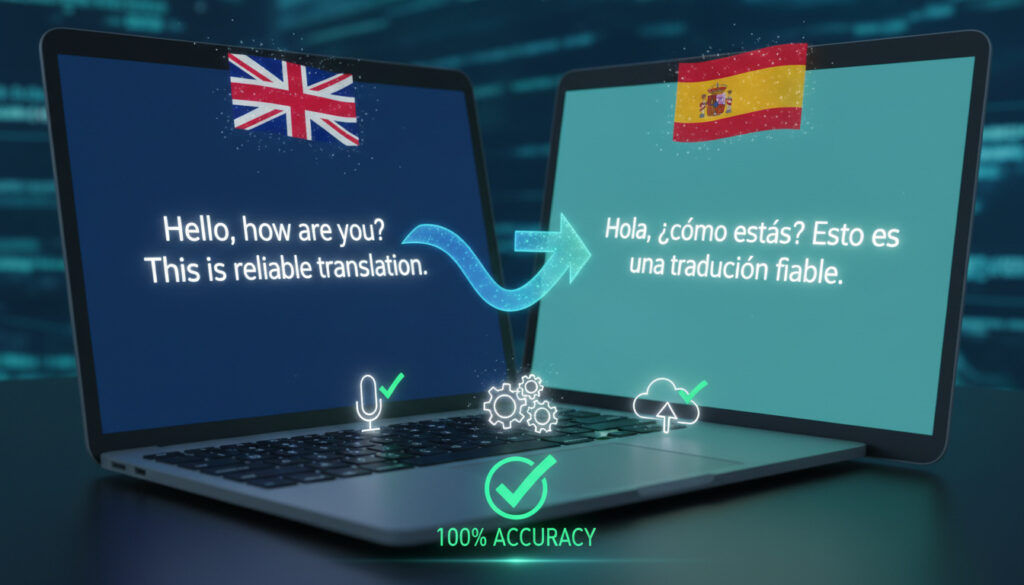
English to Spanish Translation – Best Tools and Accuracy Guide
English to Spanish translation has become a daily necessity for over 500 million users worldwide, powering everything from casual travel conversations to complex business negotiations. The landscape shifted dramatically after 2017, when neural machine translation replaced rigid word-for-word systems with context-aware algorithms that understand nuance and tone. Today’s leading platforms handle everything from voice dictation to document batch processing, yet significant differences remain in how they manage regional dialects, formal address forms, and idiomatic expressions.
Contemporary evaluations consistently identify two dominant forces in the field. DeepL and Google Translate lead 2024-2025 comparisons for distinct strengths: DeepL excels in contextual accuracy particularly for European Spanish variants, while Google Translate offers unparalleled breadth with support for 249 languages and offline functionality across 59 tongues. Professional linguists note that choice between these tools depends heavily on whether users prioritize grammatical precision or versatile accessibility across devices and network conditions.
The selection process grows more complex when accounting for specialized needs. Travelers require offline voice capabilities, legal professionals demand consistent formal register handling, and students need pronunciation feedback and verb conjugation support. Understanding these distinctions prevents the common pitfalls of literal mistranslations that have plagued automated systems since their inception.
What is the best English to Spanish translator?
Determining the optimal translation solution requires matching specific capabilities to user scenarios. The current market divides cleanly between general-purpose powerhouses and specialized linguistic tools, each addressing different accuracy thresholds and functional requirements.
Google Translate, DeepL, and SpanishDict dominate user preference ratings for English-Spanish pairs, with Reverso Context and Microsoft Translator serving specific niche requirements.
Simple text achieves 85-95% accuracy across major platforms, though complex sentences reveal significant performance gaps between neural and statistical engines.
Core functionality requires no payment for all major web-based translators, though offline mode and camera translation often hide behind premium tiers.
Casual communication favors Google Translate’s versatility, while professional drafting prefers DeepL’s contextual nuance handling.
Key distinctions emerge when examining operational details across platforms:
- DeepL frequently earns top ratings for contextual accuracy, particularly with European Spanish variants, offering alternative translations for formal and informal address forms that competitors often miss.
- Google Translate provides the broadest feature set including offline support for 59 languages, voice input, and image translation, though results remain inconsistent with complex syntactic structures.
- SpanishDict integrates comprehensive dictionary functions with conjugation charts and audio pronunciation, making it superior for educational contexts despite supporting only the English-Spanish pair.
- Reverso Context emphasizes example sentences drawn from real-world usage, helping users understand how translations function within specific contexts rather than in isolation.
- Microsoft Translator enables real-time conversation modes that split screens between languages, facilitating bilingual dialogue better than unidirectional text systems.
- Hardware alternatives like Pocketalk achieve 99% accuracy rates for Spanish-English pairs while operating independently of smartphone connectivity.
- Free tiers suffice for occasional use, but document batch processing and advanced camera functions typically require subscription upgrades.
| Platform | Language Scope | Offline Capability | Document Handling | Voice Features |
|---|---|---|---|---|
| Google Translate | 249 languages | Yes (59 languages) | Upload & copy-paste | Real-time conversation |
| DeepL | 35 languages | No | File upload (docx, pptx) | Text-to-speech output |
| SpanishDict | English-Spanish only | Yes (premium) | Limited | Pronunciation audio |
| Reverso Context | 28 languages | Yes | Web-based only | Voice-to-text input |
| Microsoft Translator | 100+ languages | Yes (language pairs) | App integration | Split-screen conversation |
How accurate is Google Translate for English to Spanish?
Google Translate serves approximately one billion users monthly, yet its performance varies significantly based on text complexity and regional target specifications. Independent evaluations reveal a bifurcated accuracy profile: simple declarative sentences achieve near-human parity, while subordinate clauses and cultural idioms generate measurable error rates.
When translating the phrase “I hope you’re well,” Google Translate typically returns a single standard form, whereas DeepL provides alternatives including the informal tú, formal usted, and plural vosotros variants required for different social contexts. This distinction proves critical in Spanish, where register selection signals social hierarchy and professional respect.
How to get accurate English to Spanish translations?
Maximizing translation fidelity requires specific procedural adjustments rather than blind reliance on default outputs. Users should segment complex sentences into shorter declarative units, specify target regions when platforms allow such configuration, and verify idiomatic expressions against specialized dictionaries.
Professional translators recommend cross-referencing machine outputs with context-specific databases. Comparative testing demonstrates that DeepL’s neural architecture handles European Spanish formal registers with greater consistency than Google’s statistical-leaning engine, particularly regarding the distinctive vosotros conjugations used in Spain but absent in Latin American variants.
How do I translate English to Spanish online for free?
Zero-cost translation has democratized cross-lingual communication, with major platforms funding robust free tiers through enterprise licensing or advertising revenue. The operational workflow remains consistent across services: users input text via keyboard, voice, or camera, select target parameters, and receive instantaneous output suitable for casual comprehension or draft-level professional work.
For converting PDF documents to editable Word formats prior to translation, dedicated conversion tools preserve formatting integrity better than direct copy-paste methods. Once converted, Google Translate and DeepL accept file uploads up to 5MB and 10MB respectively, maintaining original document structure while translating content.
Are there free English to Spanish translation tools?
The zero-cost ecosystem extends beyond the primary web interfaces. Microsoft Translator offers offline language packs for travelers without roaming data, while SayHi Translate provides adjustable playback speeds for pronunciation training. Voice-centric applications like Speak & Translate deliver rapid audio conversion without subscription requirements, though persistent usage typically necessitates premium upgrades for advanced features.
Can I translate documents from English to Spanish?
Document translation requires format-specific considerations. Web-based tools handle plain text and Microsoft Office files natively, while PDFs often need pre-conversion to extract translatable text layers. Official documents requiring certified accuracy, such as legal contracts or immigration paperwork, demand human verification regardless of machine output quality, as automated systems lack the liability coverage and notarial authority required for formal submissions.
What are tips for better English to Spanish translations?
Achieving publication-quality output from automated systems requires understanding inherent limitations in machine cognition. Current algorithms excel at literal semantic transfer but struggle with culturally embedded meanings, tonal subtleties, and domain-specific terminology found in medical, legal, or literary texts.
Machine translators consistently falter with idioms and regional address conventions. Cultural sensitivity training in newer AI models attempts to bridge this gap, but users should manually verify phrases involving time expressions, emotional states, or business formality to prevent potentially embarrassing register errors.
What is the difference between machine and human translation?
The capability divergence centers on contextual interpretation versus literal conversion. Machines process patterns across billions of parallel texts, identifying statistical correlations between words without understanding cultural subtext. Human translators apply sociolinguistic awareness that recognizes when literal accuracy conflicts with communicative intent.
Professional translation services maintain superiority for legal contracts, medical records, and marketing materials where liability and brand reputation hang on precise nuance. Conversely, machine solutions suffice for travel navigation, informal correspondence, and internal drafting where speed and cost efficiency outweigh perfect polish.
How has English to Spanish translation technology evolved?
The trajectory from primitive substitution algorithms to contextual neural networks spans less than two decades, yet represents a fundamental shift in computational linguistics. Understanding this progression explains current capability gaps and anticipates near-term improvements.
- : Google Translate launches with statistical machine translation, applying probability models derived from United Nations document corpora to generate word-for-word substitutions that often produced incoherent phrasing.
- : DeepL introduces neural machine translation architecture specifically optimized for European language pairs, demonstrating that deep learning could capture syntactic relationships missed by statistical methods.
- : Major platforms integrate transformer architectures and offline capabilities, with Google expanding offline support to 59 languages while improving handling of informal register variations.
- : Real-time AI translation emerges with cultural sensitivity modules, enabling devices like Pocketalk to achieve 99% accuracy rates while processing regional accents and generating conversation summaries automatically.
What are the established limits of automated translation?
Distinguishing between proven capabilities and persistent uncertainties helps users set appropriate expectations and avoid critical errors in high-stakes communications.
| Established Capabilities | Remaining Uncertainties |
|---|---|
| Simple text achieves 85-95% accuracy across major platforms | Literary translation quality remains unverified for stylistic nuance |
| DeepL leads in European Spanish contextual accuracy | Regional slang performance varies unpredictably by platform |
| Google Translate supports 249 languages with offline functionality | Legal liability for machine errors remains undefined in most jurisdictions |
| Voice translation reaches 99% accuracy in controlled conditions | Medical terminology consistency lacks clinical certification standards |
| Formal vs informal address forms identifiable by advanced systems | Business register appropriateness requires human verification |
Why do English to Spanish translations vary by region?
Spanish represents not a monolithic tongue but a family of variants spanning four continents, with divergent vocabulary, pronunciation, and grammatical conventions. Spain’s Castilian Spanish employs the vosotros plural informal address form absent throughout the Americas, while Mexican, Argentine, and Caribbean variants exhibit distinct lexical preferences for common objects and actions.
Machine translators increasingly allow regional specification, yet default settings often default to Castilian or Mexican norms that alienate users in Colombia or Chile. The formal usted versus informal tú distinction carries significant social weight; automated systems occasionally mismatch register to context, potentially offending business contacts or appearing inappropriately casual in formal correspondence. Users must manually specify target demographics when platforms permit such granularity, or prepare to edit outputs for regional appropriateness.
What do professional evaluations reveal about translation quality?
Third-party assessments from linguistics professionals and translation industry organizations provide objective benchmarks beyond manufacturer claims. These evaluations consistently highlight the tension between accessibility and precision.
DeepL is frequently rated highest for contextual accuracy, especially European Spanish, providing alternative forms like tú, usted, and vosotros for phrases such as ‘I hope you’re well,’ which Google Translate often misses.
Professional reviews note DeepL’s preference among translators for quality, though Google remains most accessible.
Pocketalk achieves 99% Spanish-English accuracy with 74 language support and two-year data connectivity, representing the current hardware benchmark for traveler-focused communication.
— Timekettle Voice Translation Analysis
What should guide your English to Spanish translation choices?
Selecting appropriate tools demands honest assessment of accuracy requirements and contextual stakes. DeepL and Google Translate provide capable free foundations for most casual and semi-professional needs, with the former excelling in European nuance and the latter offering unmatched versatility and offline resilience. For document workflows or official paperwork, preliminary machine drafts require human refinement to navigate regional variants, idiomatic hazards, and formal register requirements that algorithms still process imperfectly.
Common questions about English to Spanish translation
What are the best apps for English to Spanish translation?
DeepL leads for contextual accuracy, Google Translate offers offline versatility, and SpanishDict provides educational features with pronunciation guides. Professional evaluations consistently rank these three highest for distinct use cases.
Can I use translation apps without internet access?
Google Translate, Microsoft Translator, and SpanishDict offer offline modes, though language packs require prior download. DeepL currently requires persistent connectivity.
Which Spanish variant should I select in translation tools?
Specify “Latin American Spanish” for Mexico, Central and South America, or “European Spanish” for Spain to ensure appropriate vosotros usage and regional vocabulary.
Are voice translation features reliable?
Voice-to-text achieves 99% accuracy in controlled environments for clear speakers, though background noise and strong accents reduce performance across all tested platforms.
When is professional human translation necessary?
Legal contracts, medical records, and certified immigration documents require human translators with liability coverage, as machine output lacks notarial validity and guaranteed accuracy.
How do I handle idiomatic expressions in machine translation?
Verify idioms manually using WordReference or Linguee dictionaries, as machines often translate literally. Transync AI and newer tools now include cultural sensitivity training for common phrases.
More related posts
 Mark Gatiss: Husband, Net Worth, Age, Religion, Career
 Download Lasting Power of Attorney Forms: UK & Ireland
 Heather Watson: Partner, Ethnicity, Illness, Ranking & Net Worth
 Brigitte Macron: Children, Age Gap, and Wig Rumors
 Houses for Sale Bedford – Prices Trends and Best Areas
 Kaya Scodelario: Age, Husband, Children, Movies & TV
 Jack Fincham Jail Sentence Appeal: Where Is He Now