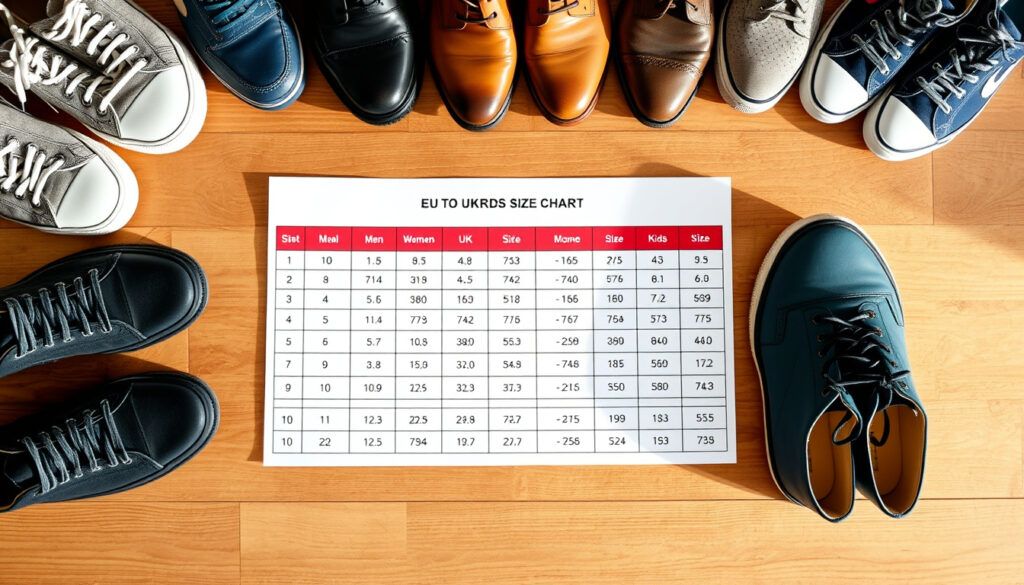
EU to UK Shoe Size – Conversion Chart for Men, Women, Kids
Converting EU shoe sizes to UK sizes requires understanding that European sizing typically runs one to two sizes larger than British equivalents for adult footwear. Whether shopping for men’s dress shoes, women’s heels, or children’s sneakers, knowing the precise conversion helps avoid ill-fitting purchases. This guide provides comprehensive conversion charts, practical fitting advice, and insights into how major brands handle sizing differences.
Size discrepancies between the EU and UK systems stem from fundamentally different measurement approaches. The European system uses centimetre-based sizing derived from foot length, while the UK system historically relies on barleycorn units—each equivalent to approximately one-third of an inch. These divergent methods create the size gap that shoppers encounter when buying across systems. Multiple retailers and sizing guides offer conversion charts, though minor variations exist between sources, making direct foot measurement the most reliable starting point for any purchase.
EU to UK Shoe Size Chart
The following table presents consolidated conversion data drawn from multiple sizing authorities. While charts provide useful reference points, slight variations occur depending on the source consulted. For the most accurate fit, measuring your actual foot length in centimetres remains preferable to relying solely on size labels.
| EU Size | UK Men’s | UK Women’s | Approx. Foot Length (cm) |
|---|---|---|---|
| 37.5 | 4 | 5.5 | 23.5 |
| 38 | 5 | 6 | 24 |
| 39 | 6 | 6.5-7 | 24.5 |
| 40 | 6.5-7 | 7.5 | 25 |
| 41 | 7.5 | 8 | 26 |
| 42 | 8 | 8.5-9 | 26.5 |
| 43 | 9 | 9.5 | 27.5 |
| 44 | 9.5-10 | 10.5 | 28 |
| 45 | 10.5 | 11.5 | 29 |
Key Insights on EU to UK Sizing
- European sizes generally run 1.5 to 2 sizes larger than UK equivalents for adult footwear
- The size differential becomes more pronounced in larger sizes
- Half-sizes exist in both systems but may not align directly
- Gender-specific charts differ, as women’s shoes typically run narrower than men’s
- Foot width varies by brand and may affect fit more than length conversion
- International size standards permit manufacturer discretion, creating unavoidable variation
Men’s EU to UK Shoe Sizes
Men’s footwear conversions follow consistent patterns across most sizing charts, though notable exceptions exist for specific brands and shoe types. Understanding where your measurements fall within these ranges helps narrow down the correct purchase size before trying shoes on.
Standard Men’s Conversions
For men, EU sizes map to UK sizes with approximately 1.5 to 2 size points of difference. An EU size 40 typically corresponds to a UK 6.5 to 7, while an EU 44 aligns with a UK 9.5 to 10. Retailers like Laughing Hens and Grivet Outdoors publish similar conversion ranges, with minor discrepancies at half sizes.
Finding Your Size in Men’s Shoes
When converting men’s sizes, consider that UK sizing uses barleycorns (approximately 8.47mm each), while EU sizing derives from true centimetre measurements of the foot. This technical difference means the numerical relationship between systems is approximate rather than exact. Many retailers recommend using an online conversion calculator that incorporates foot length measurements for greater precision.
Women’s EU to UK Shoe Sizes
Women’s shoe sizing introduces additional complexity because EU and UK women’s systems often align more closely than men’s sizes do. Some sources show differences of only 0.5 to 1 size between systems, making direct conversion less intuitive than for men’s footwear.
Standard Women’s Conversions
According to Famous Footwear’s sizing charts, EU women’s sizes generally correspond to UK sizes with a 1.5 to 2 size difference. An EU 37 converts to approximately UK 4, while EU 40 aligns with UK 6.5. The Laughing Hens chart shows slightly different mappings at smaller sizes, starting at EU 35.5 rather than EU 35, which demonstrates why consulting multiple sources improves conversion accuracy.
Width and Style Considerations
Women’s shoes often feature narrower cuts than their men’s counterparts, regardless of the sizing system used. High heels, pointed-toe designs, and fashion footwear may fit differently than casual or athletic styles. Some European brands size their women’s shoes using gender-neutral conventions, further complicating conversions. Checking brand-specific sizing guidance helps account for these variations.
Nike footwear typically runs narrow, and many buyers find they need to size up by half a UK size from what conversion charts suggest. Adidas generally stays true to EU sizing but may lengthen slightly with break-in wear. Consulting each brand’s official size guide before purchasing provides the most reliable fit information.
Kids’ EU to UK Shoe Sizes
Children’s shoe sizes require special consideration because feet grow rapidly and sizing systems vary more widely between manufacturers. EU and UK children’s sizes generally track closely, but the transition from toddler to youth sizes and eventually to adult sizing creates potential confusion.
Little Kids (Toddlers and Early Childhood)
| EU Size | UK Size | US Size (Reference) |
|---|---|---|
| 16-18 | 0-1 | 1-2 |
| 19-20 | 2-3 | 3-4 |
| 21-22 | 4-5 | 5-6 |
| 23-24 | 6-7 | 7-8 |
Big Kids (School Age)
| EU Size | UK Size | US Size (Reference) |
|---|---|---|
| 27-28 | 9-10 | 10.5-11 |
| 29-30 | 11-12 | 12-13 |
| 31-33 | 12.5-13.5 | 13.5-1Y |
| 34-35 | 1-2 | 2-3 |
| 36-37 | 3-4 | 4-5 |
Children’s feet should have approximately 1cm of additional space beyond their measured length to accommodate growth. Experts recommend remeasuring foot size every three to six months during growth spurts. Brands like Clarks publish interactive fitting guides that account for growth allowances.
Key Differences and Fitting Tips for EU vs UK Shoes
Understanding why EU and UK sizing systems diverge helps explain the conversion challenges shoppers face. These differences stem from historical conventions, measurement standards, and the absence of a universal sizing regulation across markets.
Why the Systems Differ
The European sizing system uses foot length measured in centimetres, with each full size representing approximately 6.67mm of length. The UK system relies on the barleycorn, a historical unit equal to one-third of an inch (approximately 8.47mm). Because these base units differ, conversions between systems produce imperfect mappings that include half-sizes to bridge gaps.
Practical Fitting Advice
- Measure both feet standing upright, as foot size can differ between left and right
- Take evening measurements when feet have naturally expanded throughout the day
- Add 0.5 to 1cm of allowance beyond your measured foot length
- Try on both shoes before purchasing, as fit inconsistencies occur in manufacturing
- Consider that leather shoes may stretch slightly with wear while synthetic materials maintain their shape
- Width considerations matter: EU charts are often unisex while UK charts account for gender-specific width differences
Relying exclusively on size labels without accounting for brand-specific variations frequently leads to poor fit. A UK size 8 in one brand may feel notably different from another, even when both are marked as EU 42. Always verify fit through measurement or trying on whenever possible.
How to Measure Your Feet for the Best Fit
Accurate foot measurement forms the foundation of reliable size conversion. When charts and calculators produce uncertain results, returning to direct measurement provides clarity. Several methods exist for measuring feet at home with reasonable accuracy.
Step-by-Step Measurement Process
- Place a sheet of paper on a hard floor surface against a wall
- Stand with your heel pressed firmly against the wall
- Place your full weight on the foot being measured
- Trace the outline of your longest toe and the sides of your foot
- Measure the distance from the wall to the longest toe point
- Add approximately 0.5 to 1cm to account for movement and growth
- Compare your measurement in centimetres against brand-specific size charts
This approach, recommended by Grivet Outdoors and Clarks fitting guides, works for most adult shoe purchases. Children and individuals with unusual foot shapes may benefit from professional fitting services available at specialty footwear retailers.
What to Know Before You Buy
Certain aspects of EU to UK shoe size conversion remain established fact, while others involve acknowledged uncertainty. Being aware of both categories helps set realistic expectations for online and in-store purchases.
| Established Information | Areas of Variation |
|---|---|
| EU sizes typically run larger than UK equivalents | Exact size differential varies by half-size increments |
| Foot length in cm provides universal measurement standard | Brand-specific cuts can alter fit significantly |
| Children’s sizes require regular remeasurement | Toddler sizing boundaries differ between manufacturers |
| Half-sizes exist in both systems to bridge gaps | Some brands omit half-sizes in certain styles |
| Major brands publish their own conversion charts | Retailer charts may differ slightly from brand charts |
Why EU and UK Systems Exist Separately
The coexistence of multiple sizing systems reflects historical development rather than deliberate complexity. The UK system, using barleycorn units, developed from medieval English measurement practices. Continental Europe adopted the metric system and centimetre-based sizing during the twentieth century as part of standardisation efforts. Today, both systems serve their regional markets, creating conversion challenges for international shoppers and retailers. For a comprehensive guide, you can consult the EU to UK shoe size conversion chart here: Diki angielski.
Efforts to harmonise sizing standards through international agreements have achieved limited success. The absence of binding regulations means manufacturers retain discretion over exact sizing within their declared systems. This flexibility allows brands to adjust fits for their specific product lines but creates the variations that confuse consumers.
Expert Sources and Brand Guidance
Major footwear brands invest significantly in sizing research and publish detailed guidance for their customers. These official resources often provide the most reliable information for purchasing decisions within each brand’s product range.
Nike advises customers that their footwear may fit differently than European standard sizing suggests. Their official guidance recommends trying shoes in person when possible or consulting their size guide before ordering online. The brand notes that some styles, particularly athletic footwear, may require size adjustments based on intended use.
— Nike Size and Fit Recommendations
Adidas notes that their sizing generally follows European standards but recommends considering the specific model when selecting sizes. Certain collections with responsive cushioning technologies may fit differently than the brand’s classic styles.
— Adidas UK Size Guide
For comprehensive conversion resources, retailers like Shoe City and Famous Footwear maintain searchable charts covering multiple size systems. These resources prove particularly valuable when shopping across brands or purchasing from international retailers.
Summary and Next Steps
Converting EU shoe sizes to UK equivalents involves navigating a gap of approximately 1.5 to 2 sizes for adults, with variations depending on gender, specific size, and brand. The most reliable approach combines conversion chart reference with actual foot measurement in centimetres. When purchasing from unfamiliar brands or shopping internationally, allowing extra time to verify fit through size guides and return policies helps avoid disappointment.
For additional sizing guidance across different clothing and footwear categories, the Marks and Spencer Bra Sizes and Fitting Guide offers practical advice on measuring for apparel that follows similar sizing principles.
Frequently Asked Questions
Is EU shoe size the same as UK?
No, EU and UK shoe sizes are not the same. European sizes typically run 1.5 to 2 sizes larger than UK equivalents for adults. An EU 40 generally corresponds to a UK 6.5 to 7.
What UK size is EU 39?
EU 39 typically converts to approximately UK 6 for men’s shoes and UK 5.5 to 6 for women’s shoes. The exact conversion varies slightly depending on the source and brand.
How do I convert EU shoe size to UK?
To convert EU to UK shoe size, subtract approximately 1.5 to 2 sizes from the European size. Alternatively, measure your foot in centimetres and use an online converter to find your corresponding UK size.
What brands have the biggest differences in EU to UK sizing?
Nike tends to run small and narrow, often requiring a half-size up from standard conversions. Adidas generally stays truer to EU sizing. Fashion brands and luxury footwear may deviate more significantly from standard charts.
Can I use the same conversion for all shoe types?
Not entirely. Athletic shoes, dress shoes, boots, and sandals may fit differently even within the same brand. Width considerations and intended use affect how a given size will feel across different styles.
How often should I remeasure my feet for shoe shopping?
Adults should remeasure annually or when shoe shopping after extended periods. Children and teenagers should have their feet measured every three to six months due to growth.
Why do conversion charts show different results?
Different retailers and brands compile their charts using varying methodologies, base units, and rounding conventions. The absence of universal sizing regulations allows these discrepancies to exist legally.
More related posts
 Natasha Hamilton: Children, husband, and plastic surgery facts
 Narcissist Traits: 9 Signs of Narcissistic Personality Disorder
 Charlie Cox: Biography, Net Worth, Daredevil Role & Personal Life
 The Summer I Turned Pretty Book: Belly’s Final Choice
 The School for Good and Evil: Movie, Books & Sequel
 Andre Braugher: Cause of Death at 61, Career, Tributes
 What Is Metronidazole Used For – Uses, Dosage, Side Effects
 Orson Welles: Life, Career, and Legacy