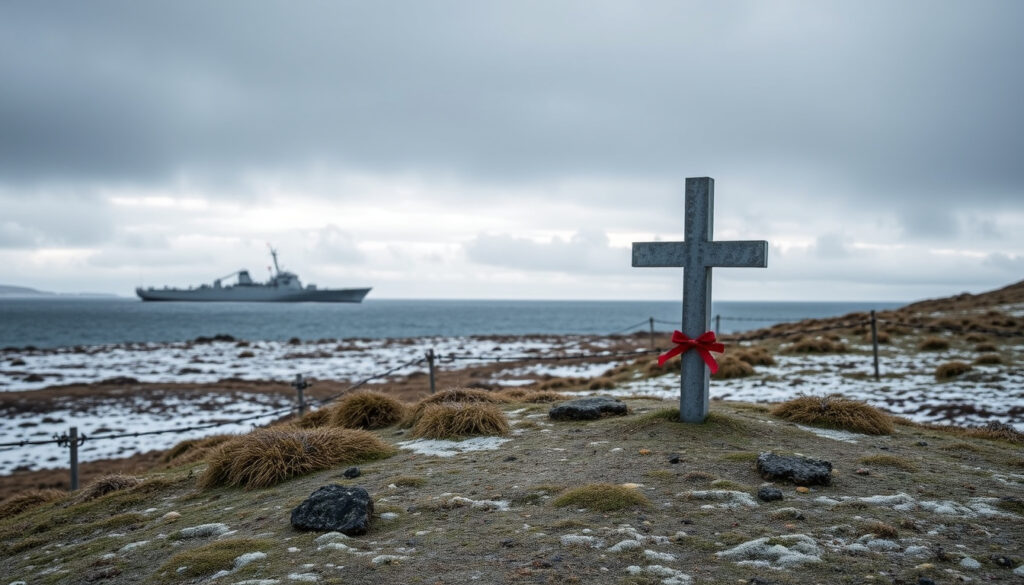
Falklands War: Causes, Timeline, Aftermath and Facts
There’s a small group of islands in the South Atlantic that most people couldn’t locate on a map in 1982—until a 74-day war put them on the front page. The conflict was brief and bloody, but it didn’t just decide who ruled the Falklands—it cemented an identity the islanders have defended ever since.
Conflict start date: 2 April 1982 ·
Ceasefire date: 14 June 1982 ·
British fatalities: 255 ·
Argentine fatalities: 649 ·
Civilians killed: 3
Quick snapshot
- Argentina invaded and occupied the Falkland Islands on 2 April 1982 (Britannica (encyclopedia))
- British Task Force departed Portsmouth on 5 April 1982 (UK Parliament House of Lords Library (legislative research body))
- Argentina surrendered on 14 June 1982 (Britannica (encyclopedia))
- 255 British and 649 Argentine military personnel died (BBC News (public broadcaster))
- Exact number of Argentine military deaths—some sources vary (Wikipedia (community encyclopedia))
- Whether future diplomatic resolution will occur (Wikipedia (community encyclopedia))
- Precise count of SAS fatalities—21 officially acknowledged, details remain classified (Wikipedia (community encyclopedia))
- Civilian death toll – some reports suggest more than three may have died (Wikipedia (community encyclopedia))
- 2 April 1982: Argentina invades (Britannica (encyclopedia))
- 5 April 1982: British Task Force departs (UK Parliament House of Lords Library (legislative research body))
- 21 May 1982: San Carlos landings (UK Parliament House of Lords Library (legislative research body))
- 14 June 1982: Argentine surrender (Britannica (encyclopedia))
- Argentina maintains constitutional claim to the Malvinas
- Falkland Islanders reaffirmed British status in 2013 referendum
- UK government refuses negotiations unless islanders consent
Eight key facts about the 1982 conflict, side by side:
| Fact | Value |
|---|---|
| Start | 2 April 1982 |
| End | 14 June 1982 |
| Duration | 74 days |
| Location | Falkland Islands, South Georgia, South Sandwich Islands |
| British Fatality Count | 255 |
| Argentine Fatality Count | 649 |
| Civilians Killed | 3 |
| Result | British victory, status quo ante bellum |
What was the reason for the Falklands War?
Argentina’s sovereignty claim
- Argentina inherited a territorial claim from Spain dating back to the 1760s and has long asserted that the islands—known in Argentina as the Malvinas—are rightfully theirs (BBC News (public broadcaster)).
- The military junta that ruled Argentina in 1982 used the claim to rally nationalist support and distract from a collapsing economy (Britannica (encyclopedia)).
British administration and islander self-determination
- Britain had administered the Falklands continuously since 1833, and the islanders—numbering fewer than 2,000—identified as British and wanted to remain so (UK Government (official foreign policy statement)).
- The UK government maintains that the principle of self-determination must guide any future sovereignty discussion (UK Government (ministerial statement)).
Invasion of 2 April 1982
- On 2 April 1982, Argentine forces landed on the Falklands and quickly overwhelmed the small British garrison (Wikipedia (community encyclopedia)).
- The following day, Argentina also seized South Georgia (Wikipedia (community encyclopedia)).
The invasion wasn’t just about islands—it was a gamble by a failing regime. For the islanders, the consequences were immediate: 74 days of occupation, and a war that would decide their political future.
The implication: The invasion was both a symptom of Argentina’s historical grievance and a desperate gamble by a failing regime.
How did Argentina react to losing the Falklands War?
Immediate political fallout
- The military junta collapsed in 1983, replaced by a democratic government (Britannica (encyclopedia)).
- Leopoldo Galtieri, the junta leader, was stripped of his post and later prosecuted for human rights abuses and mismanagement of the war.
Long-term diplomatic stance
- Argentina has never formally renounced its claim to the islands. The 1994 constitution enshrines the claim to the Malvinas, South Georgia, and the South Sandwich Islands as a permanent national objective (BBC News (public broadcaster)).
- Every Argentine president since the war has maintained the claim, though the rhetoric has softened under democratic governments.
Shift in Argentine foreign policy
- Argentina has pursued diplomatic channels at the United Nations and the Organization of American States, calling for bilateral negotiations (UK Government (statement to OAS)).
- The UK refuses to discuss sovereignty unless the islanders wish it, leaving the dispute frozen.
The implication: Defeat didn’t end the claim—it shifted it from the battlefield to the negotiating table, where it remains today.
Who won the Falklands War?
British victory
- British forces retook Port Stanley on 14 June 1982, and more than 11,000 Argentine soldiers surrendered the following day (UK Parliament House of Lords Library (legislative research body)).
- The UK maintained sovereignty over the Falklands, South Georgia, and the South Sandwich Islands.
Ceasefire terms
- The ceasefire ended hostilities on 14 June 1982, with all Argentine forces withdrawing and the islands returning to British control (Britannica (encyclopedia)).
- No formal peace treaty was signed; the state of war was eventually lifted by mutual agreement.
Strategic outcomes
- The war confirmed the UK’s ability to project military power over 8,000 miles—a key strategic lesson for NATO.
- For Argentina, the loss discredited the military regime and accelerated the return to democracy.
The pattern: The UK won the war, but the dispute over sovereignty continues to shape relations between the two countries.
How many British people died in the Falklands War?
British military fatalities (255)
- 255 British servicemen lost their lives during the conflict (BBC News (public broadcaster)).
- Of these, 86 were Royal Navy, 124 were Army, 26 were Royal Marines, and 19 were Royal Fleet Auxiliary, Merchant Navy, or other personnel.
Argentine military fatalities (649)
- 649 Argentine military personnel died (BBC News (public broadcaster)).
- The sinking of the General Belgrano alone killed more than 300 crew members (UK Parliament House of Lords Library (legislative research body)).
Civilians killed (3)
- Three Falkland Islander civilians died during the war (BBC News (public broadcaster)).
- They were killed by Argentine shelling and friendly fire.
The catch: The death tolls are often cited as 255–649, but some Argentine sources claim higher numbers. The exact count remains a point of minor dispute.
For the UK, the 255 dead were a heavy price for a small island chain. For Argentina, the 649 dead were a national tragedy that hastened the end of the dictatorship.
Why does Argentina want the Falklands so much?
Territorial claim
- Argentina’s claim is rooted in the Spanish colonial era and the principle of territorial integrity—the islands lie on its continental shelf (BBC News (public broadcaster)).
- The claim is written into the Argentine constitution since 1994, making it a permanent state policy.
Nationalism and historical grievance
- The Malvinas are a potent symbol of national pride and a reminder of perceived British imperialism.
- For many Argentines, the islands represent unfinished business from the 19th century.
Resource interests—fisheries and hydrocarbons
- The waters around the Falklands are rich in squid and fish, and the area is thought to hold significant oil and gas reserves (BBC News (public broadcaster)).
- Control of the islands means control of the exclusive economic zone, which could be worth billions.
What this means: The claim is not just emotional—it’s economic. The resources in the South Atlantic make the Falklands a prize worth contesting.
Falklands War timeline
- 2 April 1982: Argentina invades and occupies Falkland Islands (Britannica (encyclopedia))
- 3 April 1982: Argentina invades South Georgia (Wikipedia (community encyclopedia))
- 5 April 1982: British Task Force departs from Portsmouth (UK Parliament House of Lords Library (legislative research body))
- 25 April 1982: British forces retake South Georgia
- 1 May 1982: British air raids begin
- 2 May 1982: HMS Conqueror sinks the General Belgrano (UK Parliament House of Lords Library (legislative research body))
- 21 May 1982: San Carlos landings (British ground forces) (UK Parliament House of Lords Library (legislative research body))
- 28 May 1982: Battle of Goose Green
- 11 June 1982: Battle of Mount Longdon
- 14 June 1982: Argentine surrender signed (Britannica (encyclopedia))
The pattern: The 74-day timeline shows a swift British military response and decisive ground campaign, ending with Argentine surrender.
Confirmed facts vs. what’s unclear
Confirmed facts
- Argentina invaded on 2 April 1982 (Britannica)
- UK won the war (Britannica)
- 255 British and 649 Argentine personnel died (BBC News)
- Falkland Islanders voted overwhelmingly to remain British in 2013 referendum
What’s unclear
- Exact number of Argentine military deaths—some sources vary (Wikipedia)
- Whether future diplomatic resolution will occur
- Precise count of SAS fatalities—21 officially acknowledged, details remain classified
What this means: While key facts are settled, the exact casualty numbers and future diplomatic outcomes remain open to interpretation.
Quotes from the conflict
“We have retaken South Georgia. Just rejoice at that news.”
— Margaret Thatcher, UK Prime Minister, April 1982
“The Malvinas are Argentine and will always be Argentine. The 1982 war was a just cause to recover what is ours.”
— Argentine military junta, official statement, 2 April 1982
“We are British and we want to remain British. That is the clear and overwhelming message from the people of the Falkland Islands.”
— Falkland Islands representative, 2013 referendum result statement
The war ended in 1982, but the sovereignty dispute remains. For Argentina, the islands are a wound that hasn’t healed. For the islanders, the war confirmed their British identity—and they have no intention of changing it. For the UK, the cost of defending that choice was 255 lives, and the commitment to protect the Falklands continues to this day.
Frequently asked questions
What was the Falklands War death toll?
The total military death toll is 904: 255 British and 649 Argentine personnel. Three Falkland Islander civilians also died.
How long did the Falklands War last?
The war lasted 74 days, from 2 April to 14 June 1982.
How many SAS soldiers died in the Falklands War?
The British government officially acknowledges 21 SAS fatalities, but precise details remain classified.
Did NATO get involved in the Falklands War?
NATO as an alliance did not participate. The UK operated independently, though some European allies provided logistical support.
What was the Falklands War timeline?
Key events: 2 April invasion, 5 April Task Force departure, 21 May landings, 14 June surrender. Full timeline above.
Who helped Britain in the Falklands War?
No formal coalition. The US provided intelligence and logistical support. Chile also provided early warning intelligence.
Do Falkland Islanders want to remain British?
Yes. In the 2013 referendum, 99.8% of islanders voted to remain a British Overseas Territory.
What is the Falklands War movie?
Several films cover the conflict, including “The Falklands War: The Untold Story” and “This Is Not a Love Song.”
Related reading
- Tim Peake: Biography, Space Mission, and Life After ESA — British military astronaut, parallels of service and national identity.
- Nazanin Zaghari-Ratcliffe: Detention, Release, and Life After — UK-Iran hostage diplomacy, another example of Britain’s overseas citizen protection.
More related posts
 Carl Cox: Biography, Net Worth, Space Ibiza Legacy
 Gustav Klimt Artist: Biography, Art Style, and Famous Paintings
 Michael Franzese: GoodFellas, Net Worth, Why He Skipped Funeral
 Josh Hartnett Biography: Career, Family, Net Worth, More
 Michael Cera Movies and TV Shows: Full List & Best Roles
 Yvonne Strahovski: Biography, Age, Husband, Children, Movies
 Rory Delap: Career, Family, and the Long Throw That Changed Football
 Amy Cudden: Biography, Age, and TV Roles