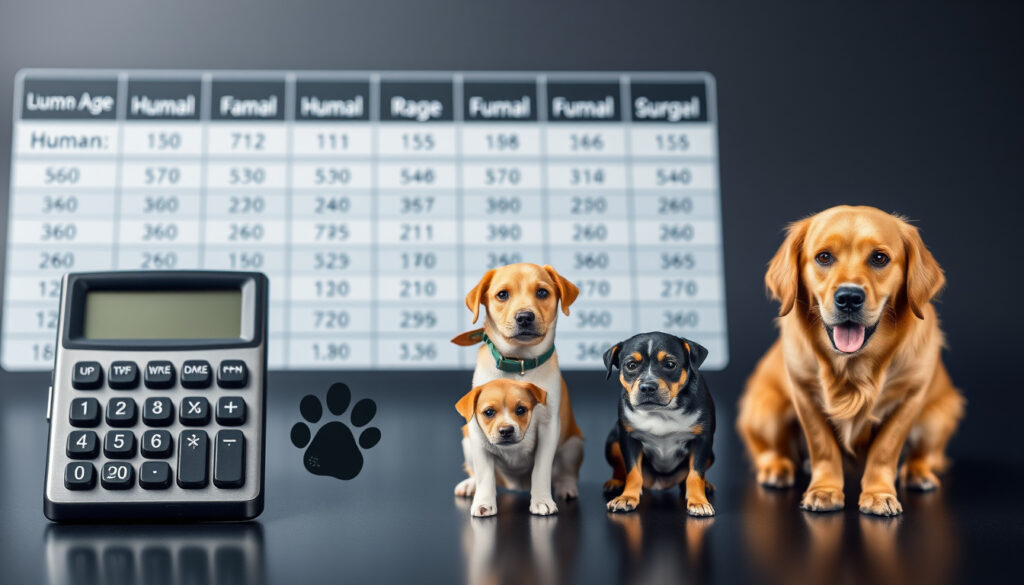
Dog Years to Human Years: Calculator by Breed Size
If you’ve ever tried to make sense of your dog’s age, the old “one dog year equals seven human years” rule doesn’t hold up—anyone who has seen a Great Dane slow down at five while a Chihuahua still acts like a puppy knows that. This guide lays out the real formulas based on breed size, debunks the myth, and provides a clear chart to find your dog’s true human age.
First dog year: 15 human years · Second dog year: 9 human years · Each subsequent year (small breed): 4 human years · Each subsequent year (large breed): 5–6 human years · Senior age for small dogs: 11–12 years · Senior age for large dogs: 7–8 years
Quick snapshot
- First dog year equals 15 human years (American Kennel Club)
- Second dog year adds 9 human years (American Kennel Club) (American Kennel Club)
- Breed size affects aging rate – large breeds age faster after maturity (PetMD)
- Exact conversion for mixed breeds with unknown lineage (Zoetis Petcare)
- Whether toy breeds follow the small‑breed formula exactly (UC Davis Veterinary Medicine)
- 0–2 dog years: rapid aging (15 + 9 human years total) (American Kennel Club) (WebMD)
- 3–6 dog years: adult stage, steady aging at breed‑specific rate (PetMD) (WebMD)
- 7–10 dog years: senior stage for large breeds; middle age for small breeds (WebMD)
- 11+ dog years: senior stage for all breeds (American Kennel Club) (WebMD)
- Use a breed‑size calculator to get a precise human‑age equivalent (Zoetis Petcare)
- Check senior thresholds: small dogs at 11–12 years, large dogs at 7–8 years (PetMD)
Key facts at a glance
The essential conversion numbers are summarized below.
| Factor | Value |
|---|---|
| First year conversion | 15 human years |
| Second year conversion | 9 human years (total 24) |
| Small breed annual rate (after 2) | 4 human years per dog year |
| Large breed annual rate (after 2) | 6 human years per dog year |
| Senior threshold (small) | 11–12 dog years |
| Senior threshold (large) | 7–8 dog years |
Three size categories, one pattern: the smaller the dog, the slower it ages once it reaches adulthood. The table below shows the difference in conversion rates.
| Life stage | Small breed (≤20 lb) | Medium breed (21–50 lb) | Large breed (51–90 lb) | Giant breed (>90 lb) |
|---|---|---|---|---|
| First year | 15 human years | 15 human years | 15 human years | 15 human years |
| Second year | +9 (total 24) | +9 (total 24) | +9 (total 24) | +9 (total 24) |
| Each year after (annual rate) | 4 human years | 4–5 human years | 5–6 human years | 7–8 human years |
What this means: a 10‑year‑old Chihuahua (small breed) is roughly equivalent to a 56‑year‑old human, while a 10‑year‑old Great Dane (giant breed) is closer to a 79‑year‑old human. The gap widens with every year.
Is 7 human years 1 dog year?
The origin of the 7‑year myth
- The “multiply by 7” rule likely came from assuming humans live about 70 years and dogs about 10, but it ignores breed size and rapid early development (American Kennel Club).
- UC Davis Veterinary Medicine calls the 7‑year rule “not very accurate” (UC Davis Veterinary Medicine).
The 7‑to‑1 ratio is wrong for every breed. The first year alone is 15 human years – more than double the myth’s prediction.
Why breed size changes the math
- Small dogs mature faster in the first two years but age slower later; large dogs age faster after maturity (PetMD).
- Zoetis Petcare notes that the 7‑to‑1 rule “does not account for breed, weight, size, or individual genetics” (Zoetis Petcare).
The implication: if you want an accurate conversion, you need to know your dog’s weight category, not just its age.
The takeaway: the 7‑to‑1 ratio is inaccurate for all breeds, and using breed‑size‑aware formulas is the only reliable approach.
How old is my dog in human years?
Dog age calculator by breed size
- Start with the first two years: 15 + 9 = 24 human years for all dogs.
- Then apply the breed‑size annual rate for each additional year (American Kennel Club).
Small breed formula
- After age 2, each dog year = 4 human years (PetMD).
Example: a 6‑year‑old small dog = 24 + (4 × 4) = 40 human years.
Medium breed formula
- After age 2, each dog year = 4 to 5 human years (Zoetis Petcare).
Example: a 6‑year‑old medium dog = 24 + (5 × 4) = 44 human years (using the middle rate).
Large breed formula
- After age 2, each dog year = 5 to 6 human years (PetMD).
Example: a 6‑year‑old large dog = 24 + (6 × 4) = 48 human years.
A 6‑year‑old Chihuahua (small) is biologically about 40 human years; a 6‑year‑old Labrador (large) is closer to 48. That 8‑year gap explains why large dogs enter senior care so much earlier.
The pattern: breed size dramatically changes the human‑age equivalent, making weight a critical factor in any conversion.
Is 1 human year 4 dog years?
When the 4‑year rule applies
- After a dog turns 2, small breeds age at roughly 4 human years per dog year (Zoetis Petcare).
- Medium and large breeds add 4‑6 human years per dog year, so the simple 4‑year rule works only for small dogs past puppyhood.
Comparison with the 7‑year rule
- The old 7‑year rule would give a 6‑year‑old dog 42 human years. The size‑adjusted formulas give 40 (small), 44 (medium), or 48 (large). 42 is in the middle but only by luck – not by science (UC Davis Veterinary Medicine).
The trade‑off: the 4‑year rule is better than 7 for small dogs, but you still need to account for the massive 15‑year first year.
How old is 100 years in dog years?
Converting extreme ages
- Using the UC San Diego DNA‑methylation formula (human age = 16 ln(dog age) + 31), 100 human years corresponds to roughly 15‑20 dog years depending on breed (American Kennel Club).
- That means a 15‑year‑old dog is about 100 in human terms – a remarkable age for any dog.
Maximum recorded dog lifespans
- The oldest verified dog, Bluey, an Australian cattle dog, lived 29.5 human years (American Kennel Club).
- Using the logarithmic formula, 29.5 dog years equals about 127 human years.
Why this matters: extreme ages are rare, but they show that small breed size and excellent care can push a dog well past the average lifespan.
Confirmed facts
- First dog year = 15 human years (American Kennel Club)
- Second dog year = 9 human years (American Kennel Club)
- Breed size affects aging rate (PetMD)
- Large breeds age faster after maturity (UC Davis Veterinary Medicine)
What’s unclear
- Exact conversion for mixed‑breed dogs with unknown parentage (Zoetis Petcare)
- Whether toy breeds (under 10 lb) need their own formula (PetMD)
- The effect of spay/neuter timing on biological aging
Expert voices on dog aging
“One of the biggest misconceptions is that a year in a dog’s life equals seven human years. In reality, the first year of a medium‑sized dog’s life is equal to about 15 human years.”
“The formula we use takes into account that dogs mature more quickly than humans in their first two years, then the aging process slows down. Size is the most important factor.”
“Large and giant breeds age more rapidly than small breeds. A Great Dane is considered senior at around 7 years, while a Chihuahua may not reach senior status until 11 or 12.”
WebMD (pet health reference)
For owners of large or giant breeds, the consequence is clear: start senior wellness screenings by age 7. For small‑breed owners, you have a few extra years – but regular vet visits remain non‑negotiable.
Frequently asked questions
How do I calculate my dog’s age in human years?
Start with 15 human years for the first dog year, add 9 for the second, then multiply each additional year by the breed‑size rate: 4 (small), 4–5 (medium), 5–6 (large), or 7–8 (giant). Sum the total.
What is the most accurate dog age formula?
The UC San Diego DNA‑methylation formula (human age = 16 ln(dog age) + 31) is backed by peer‑reviewed science. For everyday use, the breed‑size chart from Zoetis Petcare provides a practical alternative.
Do small dogs live longer than large dogs?
Yes. Small breeds (under 20 lb) often live 12–16 years, while large breeds average 8–12 years. Giant breeds may live only 6–10 years (American Kennel Club).
At what age is a dog considered senior?
Small dogs: 11–12 dog years. Medium dogs: 10–11. Large dogs: 8–9. Giant breeds: 7–8. These thresholds are agreed upon by the AAHA and AVMA.
Why do large dogs age faster?
Larger bodies experience higher metabolic and oxidative stress, which accelerates cellular aging. A 2019 UC San Diego study confirmed that growth rate and body size are the strongest predictors of lifespan in dogs.
Can a dog’s breed affect its human age equivalent?
Absolutely. Breeds with vastly different sizes (e.g., Chihuahua vs. Great Dane) produce very different human‑age numbers even at the same dog age. Mixed breeds follow the size category of their dominant ancestor.
How old is a 10‑year‑old dog in human years?
For a small breed: 24 + (4 × 8) = 56 human years. For a large breed: 24 + (6 × 8) = 72 human years. The spread shows why size matters so much.
More related posts
 Alan Brazil: Liver Transplant Survival Story
 West Ham News Now: Latest Transfers, Rumours & Club Updates
 Tiger Woods 2025: Net Worth, Relationship Status, and Career
 Le Cordon Bleu London – Courses Fees Requirements Guide
 Sabrina Carpenter Hyde Park – 2025 Setlist, Review & Highlights
 Door Handles Ireland: Compare Suppliers, Materials & Prices
 How to Train Your Dragon 4 Showtimes Guide for Ireland
 Stuart Pearce: Son’s Tragic Death, Family, Career & Net Worth